
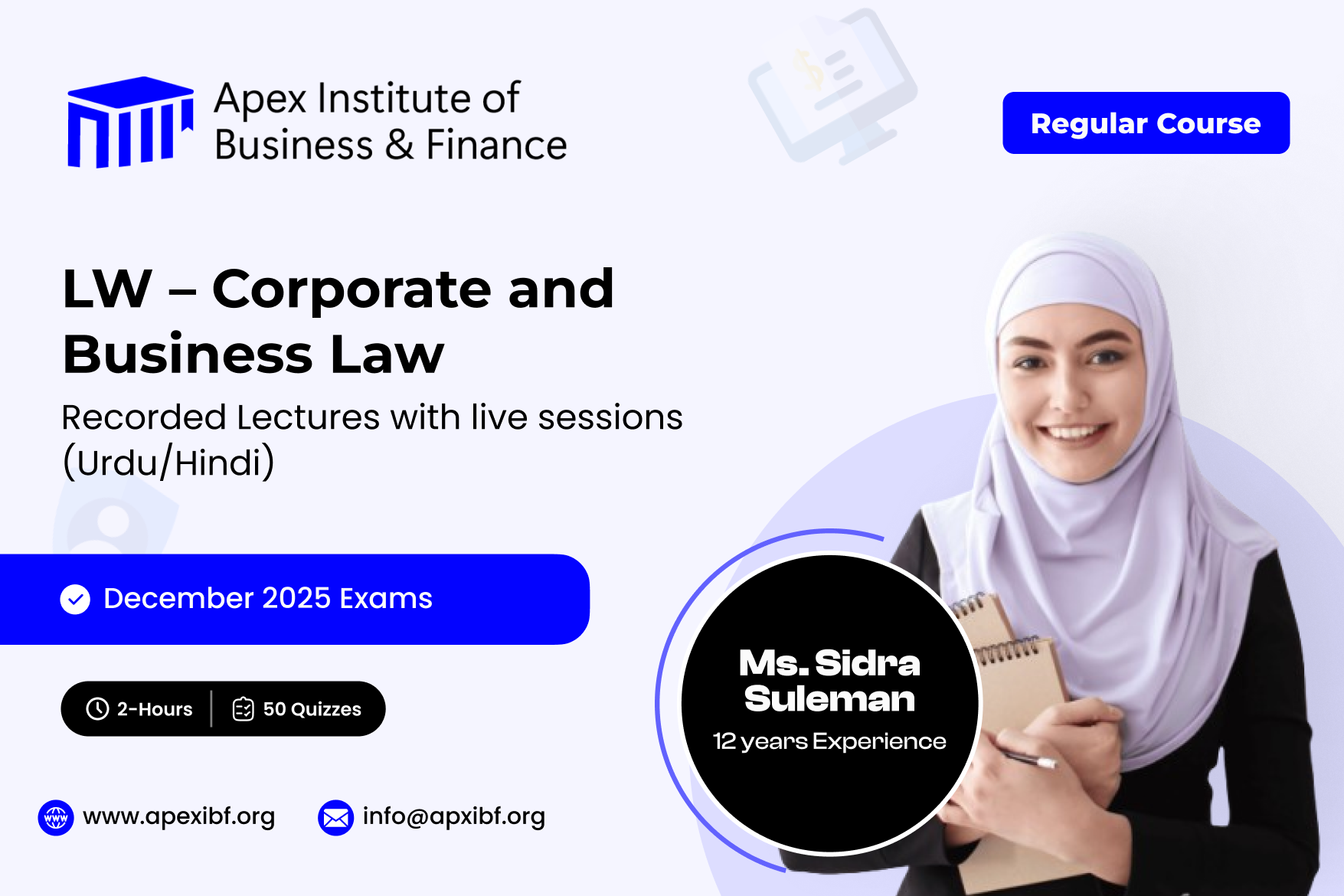
Overview
The Corporate and Business Law (LW) paper of ACCA introduces students to the essential legal framework that governs business operations and commercial transactions.
This course helps you understand how the law influences business decisions, protects stakeholders, and ensures ethical conduct. Students develop the ability to identify and apply key legal principles in areas such as contract law, employment law, company formation, and corporate governance.
What You Will Learn
By studying LW, you should be able to:
Why LW is Important
Exam Structure
|
| Total marks |
Section A: | 25 x 2 marks objective test questions | 50 |
| 20 x 1-mark objective test questions | 20 |
Section B: | 5 x 6 marks multi-task questions | 30 |
|
| 100 |
Career Relevance
Completing LW prepares you for junior-level roles where legal and compliance awareness is essential such as:
The exam consists of 50 2-mark multiple choice questions for both FA1 and MA1.
No, there is no specific knowledge of financial reporting standards or the Conceptual Framework required for FA1.
The exams consists of 50 2-mark questions for FA2 and MA2, however unlike FA1 and MA1 it contains different types of objective test question. These different types of question are number entry, multiple response and multiple response matching, which are used in addition to multiple choice questions.
Yes. The full list of financial reporting standards which are examinable under the FA2 syllabus can be found in the examinable documents list. The study guide offers more detailed guidance on the depth and level at which the examinable documents will be examined. The study guide should be read in conjunction with the examinable documents list.
The definitions of the elements of financial statements and the qualitative characteristics of financial information, listed in the conceptual framework, are examinable in FA2. Please see the study guide for further details.
No previous qualifications are required for entry at the Intermediate Certificate level (MA2/FA2) or the Diploma (FBT/FMA/FFA), however it is suggested that students who do not have any prior accountancy knowledge start at the Introductory Certificate (FA1/MA1). This ensures that you can be confident that you have the knowledge base in order to successfully proceed through the Foundation Level suite of qualifications.
The FFA/FA syllabus is designed to be suitable for candidates without any existing knowledge of the subject. Consequently the syllabus coverage is wide.
Including detailed accounting requirements for partnerships would mean that it may not be possible to examine other areas of the syllabus in sufficient detail. The basic concept of what a partnership is and how it compares to sole traders and limited liability companies is part of the syllabus - just not the detailed accounting.
The impact of this on all other ACCA exams is minimal. Once candidates have understood the basic accounting principles for a business, these are easily transferrable to any business structure.
Yes there is a specimen paper which gives an example of the exam including the longer type questions where applicable. In addition there is an additional set of specimen longer type questions for candidates to get additional practice on these questions. Interactive practice tests are available for all Foundations level exams available via on-demand assessment. Each exam has a set of three practice tests that prospective candidates can purchase singly or as a complete set. These tests replicate a live exam experience and contain the types of questions that candidates might be given at a real exam.
Not only do these tests provide a valuable experience of how to experience or navigate through such exams, they also score candidates’ performance in each main section of the syllabus, using a traffic light system to present this interactively. In addition, the questions that the candidate has got correct, partially correct and incorrect are identified for each main syllabus section. Finally feedback on each question in the paper is given so that candidates can see where they have gone wrong and which can be used as a valuable revision tool. Access to the practice tests and information on how to purchase them is on the ACCA website.



Stay updated with new course launches, upcoming batches, exam tips, free resources, and essential academic updates to support your learning journey.
Copyright © 2025 Apex IBF. All Right Reserved
Need Help? Chat with us